Unit 2 - Economic Indicators and the Business Cycle
Printable Cheat Sheets for Every Unit
Everything you need to ace your exam, all on a single page.
Download PDF Cheat SheetsTable of Contents
Built into this unit
Flashcards
77 cards mix graphs, formulas, and key terms. Shuffle blends every type so you drill the whole unit—not just one format.
2.1 - The Circular Flow and GDP
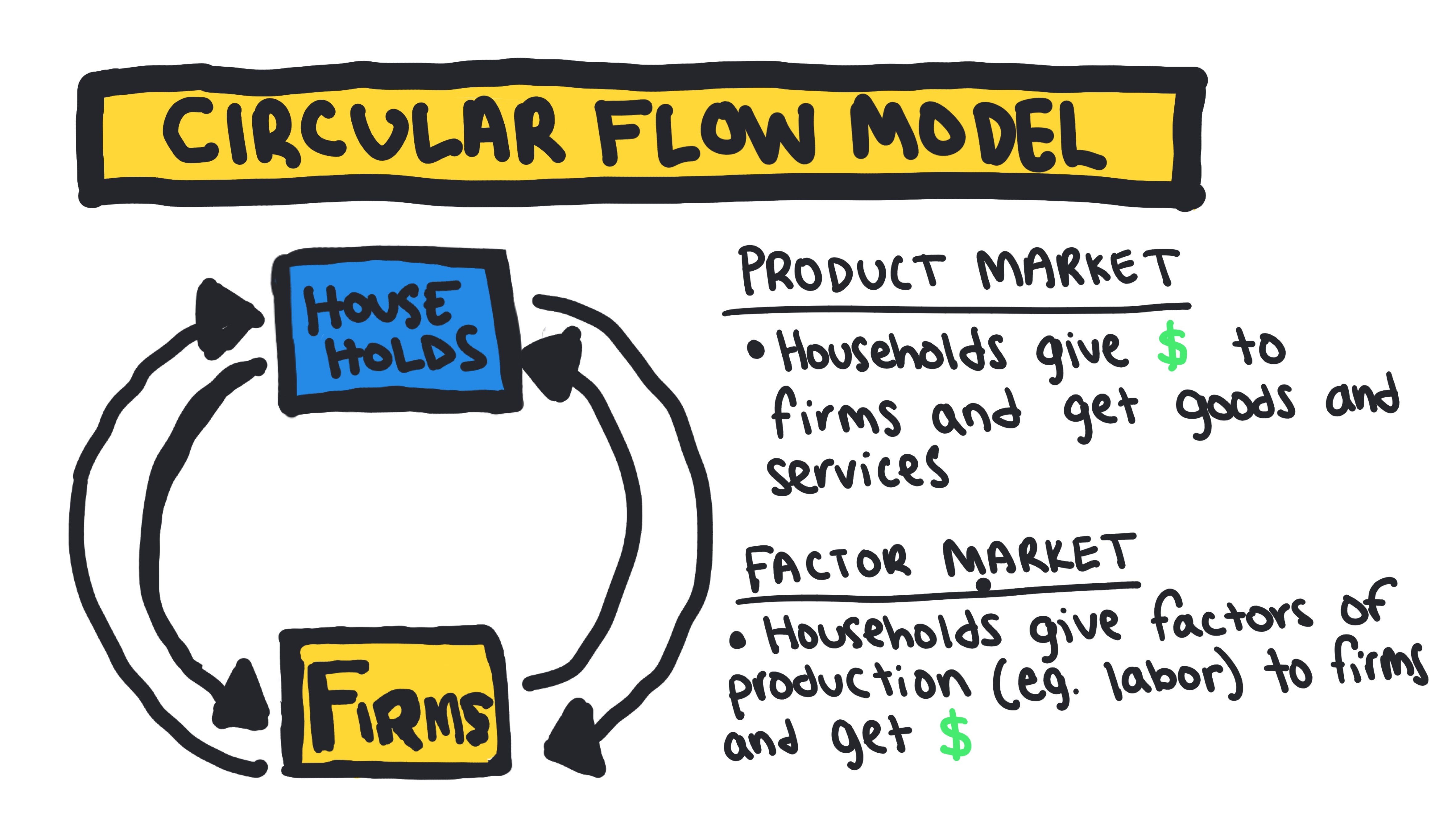
The Circular Flow Model
Learn about the circular flow model, the product and factor markets, and various leakages and injections.
Key Terms & Definitions
Economic Indicators
Different measures that economists use to determine the overall size and health of an economy, similar to how a doctor uses health indicators to assess a patient.
- •GDP
- •GDP per capita
- •Unemployment
- •Inflation
Circular Flow Model
A model showing the important interactions between different groups in an economy.
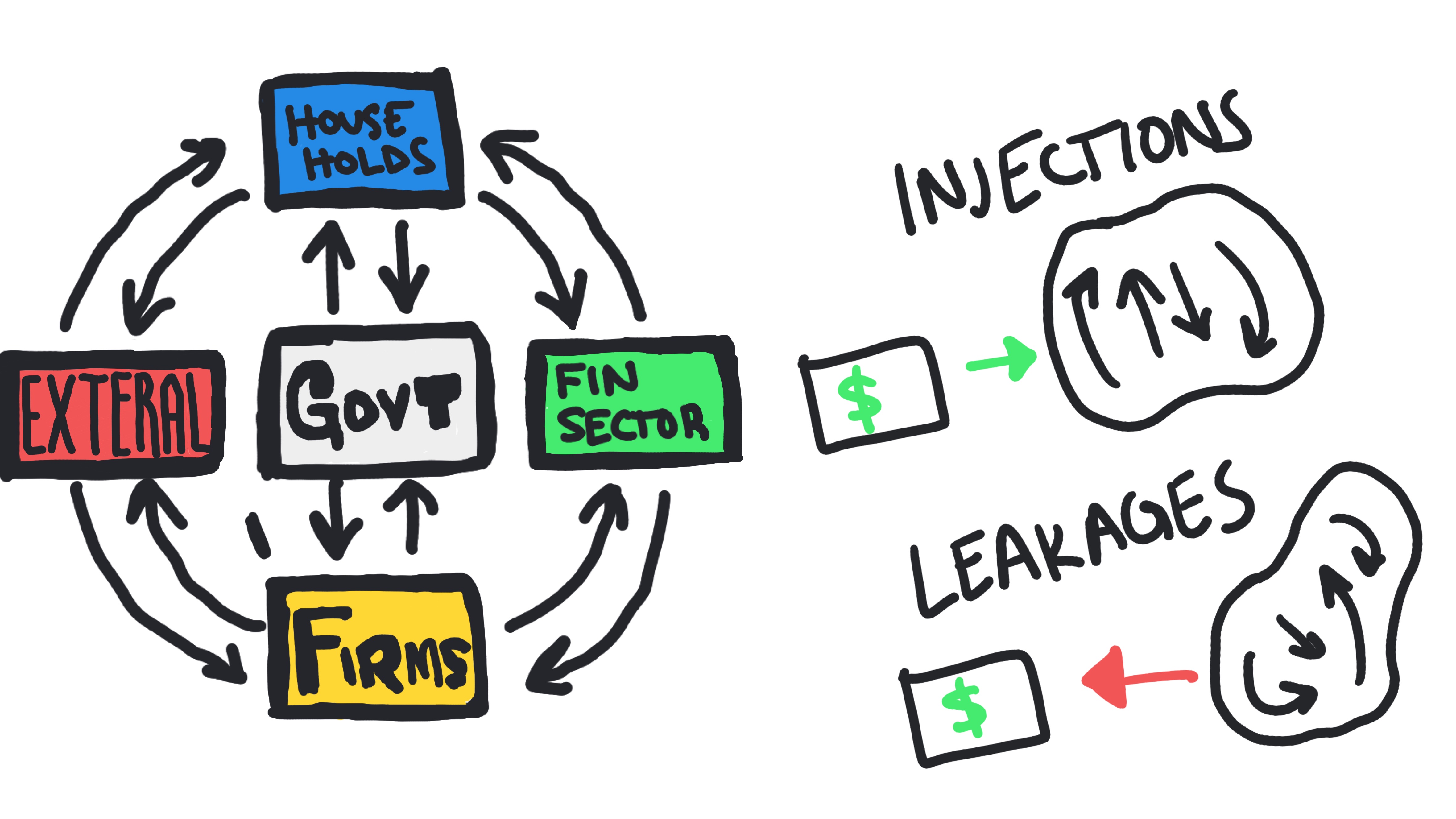
- •Depicts money and goods and services moving between households, firms, government, external sector, and financial sector.
Households
Individuals or groups who own the factors of production.
Firms
Businesses or producers.
Product Market
Anywhere households and firms interact, where households give money in exchange for goods and services.
- •Example: Going to a grocery store to buy food or a restaurant to buy a meal.
Factor Market
Anywhere that firms acquire resources, such as labor, from households.
- •Example: A worker getting hired as a chef at a restaurant.
Injections
Money that was not previously flowing through the economy being added into the circular flow.
- •Examples: Government spending, investment, exports
Leakages
Money leaving the circular flow of the economy.
- •Examples: Taxes, savings, imports
Gross Domestic Product (GDP)
The total monetary value of all final goods and services produced within a country’s borders in a given year.
- •Definition should be memorized because every word matters
Intermediate Good
A good used to help produce something else and not counted toward GDP to avoid double-counting.
- •Example: Flour used to bake a cake
Expenditure Approach
Calculating GDP by adding up all spending by households, businesses, government, and the external sector.
- •Formula: GDP = C + I + G + NX
Consumption (C)
All household spending in an economy.
- •Includes durable goods (cars, appliances), non-durable goods (food, clothing), and services (healthcare, education)
- •Some large consumer purchases (cars, houses) are interest-senssitive, meaning when interest rates decrease, consumption increases
Investment (I)
Business spending on capital goods like machines
- •Investment is interest-sensitive, meaning when interest rates decrease, investment increases
- •Careful: Investment is NOT stock purchases
Government Spending (G)
Government spending on goods and services, excluding transfer payments.
- •Examples: Military, new roads
Government Transfer Payments
Money the government gives without receiving a good or service in return, not counted in GDP.
- •Example: Unemployment benefits
Net Exports (NX)
Exports minus imports.
- •Imports are subtracted to avoid counting foreign production in GDP.
Income Approach
Calculating GDP by adding up all income earned in production.
- •Formula: GDP = W + I + R + P (Wages + Interest + Rent + Profit)
Equivalence of Approaches
Expenditure and income approaches should give the same GDP because every dollar spent becomes income for someone else.
- •Example: When you buy a 10), that 10). Both approaches count the same $10 transaction.
Whiteboards
Practice MCQs
Test your understanding of 2.1
An economy produces only apples and bananas. In one year, 100 apples are sold at $1 each, and 50 bananas are sold at $2 each. Nominal GDP for that year is:
2.2 - Limitations of GDP
Limitations of GDP
Learn about the limitations of GDP as a measure of economic well-being.
Key Terms & Definitions
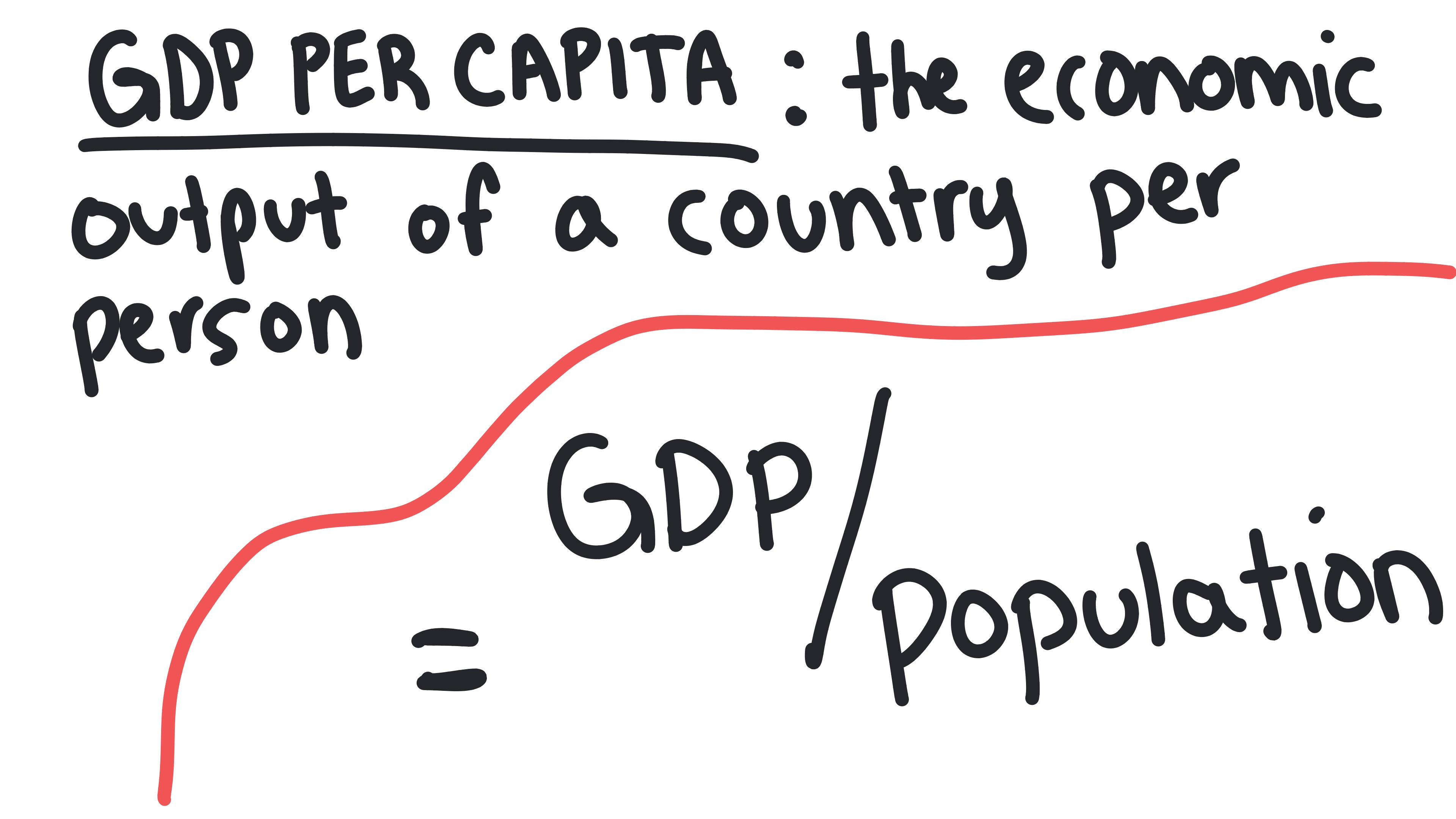
GDP per capita
GDP divided by population, giving a better measure of individual economic well-being than total GDP.
- •Formula: GDP per capita = GDP / Population
Limitations of GDP
Shortcomings of GDP as a measure of economic well-being and quality of life.
- •Population: GDP doesn't account for population size (Luxembourg has a much smaller GDP than India due to its size, but a much higher standard of living)
- •Inequality: GDP doesn't show how income and wealth are distributed among the population
- •Environment: GDP doesn't account for environmental degradation or depletion of natural resources
- •Shadow Economy: GDP doesn't include illegal activities and unreported income from the underground economy
GDP Excludes Non-Market and Underground Activities
GDP only counts goods and services that are bought and sold in official markets, overlooking unpaid work and illegal transactions.
- •GDP overlooks unpaid work like household chores, caregiving, and volunteerism
- •GDP does not include "off-the-books" or illegal transactions that occur in the underground economy
- •Example: A parent caring for their child at home is not counted in GDP, but hiring a nanny would be counted
GDP Ignores Negative Externalities
GDP does not subtract the costs of negative consequences like pollution or environmental degradation from its calculation.
- •Economic growth measured by GDP can include costs that harm society and the environment
- •Examples: Pollution from factories, depletion of natural resources, environmental damage from production
GDP Fails to Account for Income Inequality
GDP doesn't show how wealth is distributed within a country, potentially masking significant income inequality.
- •A high GDP can mask significant income inequality, where a small portion of the population holds most of the wealth
- •Example: A country with high GDP but where most people live in poverty still appears economically successful
GDP Doesn't Measure Quality of Life or Well-Being
GDP is a poor indicator of a nation's overall well-being because it doesn't measure important non-economic factors.
- •GDP doesn't measure factors like health, education, life expectancy, leisure time, or social and political freedom
- •Example: A country with high GDP but poor healthcare and education systems may have lower overall well-being
GDP Includes Unproductive Expenditures
GDP counts spending on negative events as a positive economic gain, treating them as if they are wealth-creating activities.
- •Spending on disaster recovery, crime prevention, or even the costs of war are included in GDP
- •Example: Rebuilding after a hurricane increases GDP, even though the destruction itself was harmful to society
GDP Misrepresents Progress Due to Technology and Depreciation
GDP doesn't always accurately account for improvements in product quality or efficiency, and treats replacement of depreciated capital the same as new capital creation.
- •GDP doesn't account for improvements in product quality or efficiency driven by technology
- •GDP counts the replacement of depreciated capital (e.g., a worn-out machine) the same as the creation of new capital, failing to reflect net investment
- •Example: Replacing a broken computer with an identical model counts the same as upgrading to a much better computer
Whiteboards
Practice MCQs
Test your understanding of 2.2
Which of the following is a limitation of using GDP as a measure of a country's overall well-being?
2.3 - Unemployment
Unemployment
Learn the three main types of unemployment, how to calculate a country's unemployment rate and labor force participation rate, and learn about the problem of discouraged workers.
Key Terms & Definitions
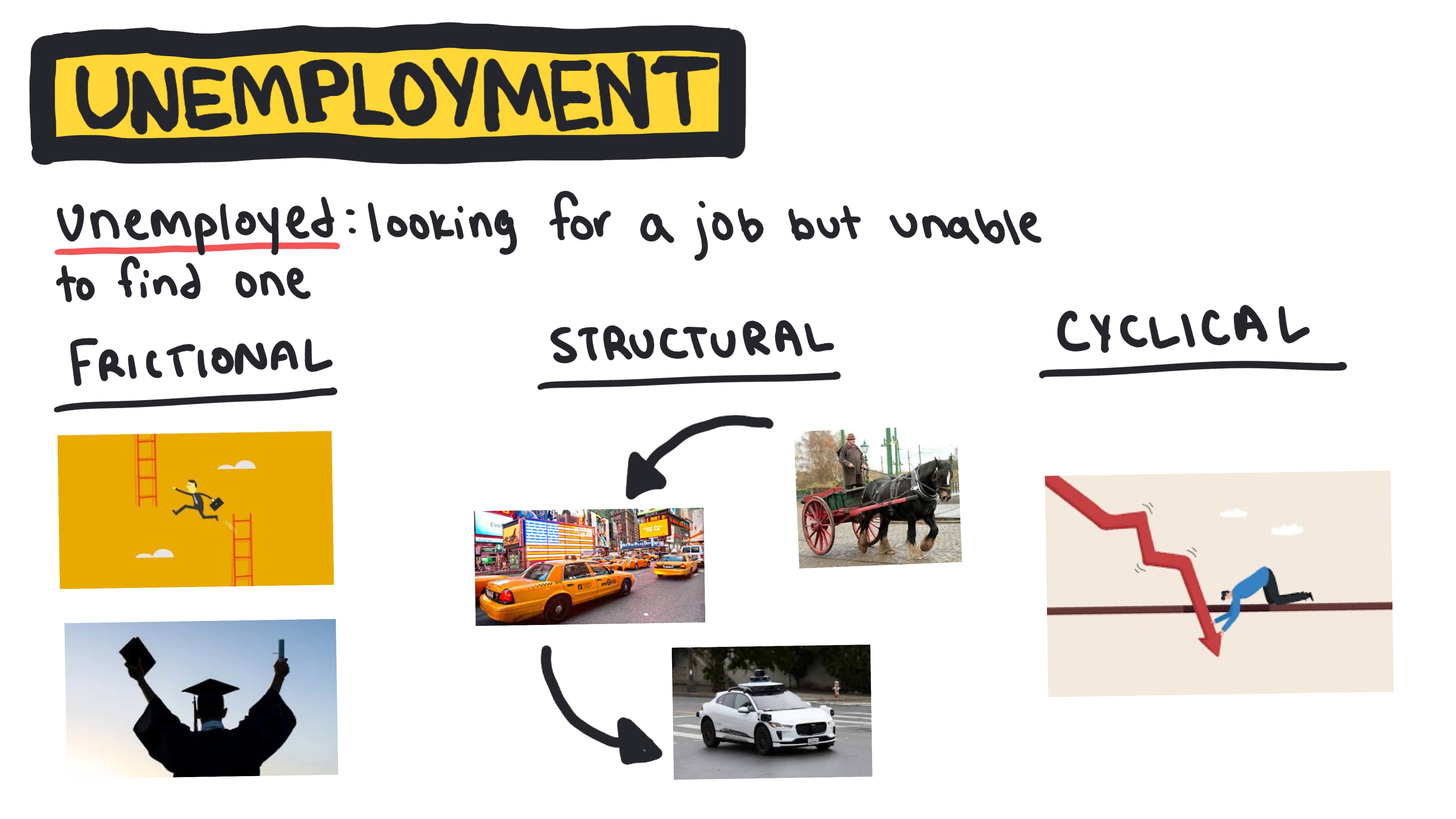
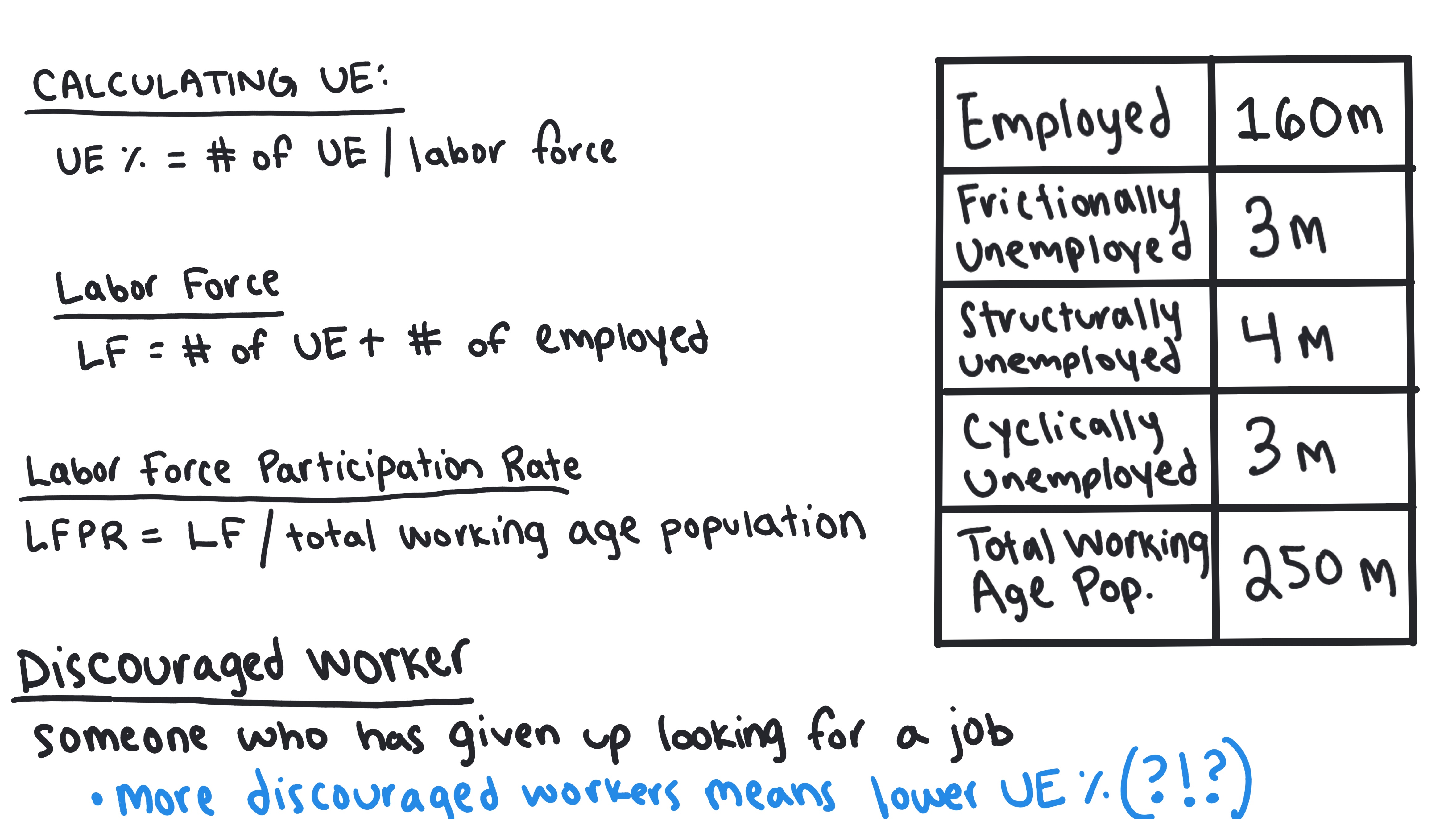
Unemployed
A person actively looking for a job but unable to find one.
- •Careful: Just because you don't have a job doesn't mean you are unemployed (discouraged workers, retired people, children).
Frictional Unemployment
Temporary unemployment between jobs.
- •Examples: A recent college graduate searching for their first job, a worker who quit their job to find a better one, someone moving to a new city and looking for work
Structural Unemployment
Unemployment caused by changes in the economy that make some skills obsolete.
- •Examples: A coal miner whose job was eliminated due to the shift to renewable energy, a factory worker whose job was replaced by automation, a typewriter repair person after computers became widespread
Cyclical Unemployment
Unemployment caused by a recession.
- •Examples: A construction worker laid off during an economic downturn, a retail employee whose store closed due to reduced consumer spending, a factory worker who lost their job when the company reduced production during a recession
Natural Rate of Unemployment
The unemployment rate when the economy is healthy; includes frictional and structural unemployment.
Labor Force
All employed and unemployed people available to work.
- •Formula: Labor Force = Employed + Unemployed
Unemployment Rate
Percentage of the labor force that is unemployed.
- •Formula: (Number of Unemployed / Labor Force) × 100
- •Shortcoming: An increase in discouraged workers causes a decrease in the unemployment rate, which is a shortcoming of the unemployment rate as an economic indicator.
Labor Force Participation Rate
Percentage of the working-age population that is part of the labor force.
- •Formula: (Labor Force / Working-Age Population) × 100
Discouraged Workers
People who have stopped looking for work after being unemployed for a long time; not counted in the unemployment rate.
- •An increase in discouraged workers causes a decrease in the unemployment rate (because they are no longer counted as unemployed or in the labor force).
Whiteboards
Practice MCQs
Test your understanding of 2.3
Suppose an economy has an adult population of 250 million, 150 million employed, and 10 million unemployed. The labor force participation rate is:
2.4 - Price Indices and Inflation
Price Indices and Inflation
Learn about price inflation, deflation, disinflation, and price indices like the Consumer Price Index (CPI).
Key Terms & Definitions
Inflation
A sustained increase in the general price level, reducing purchasing power.
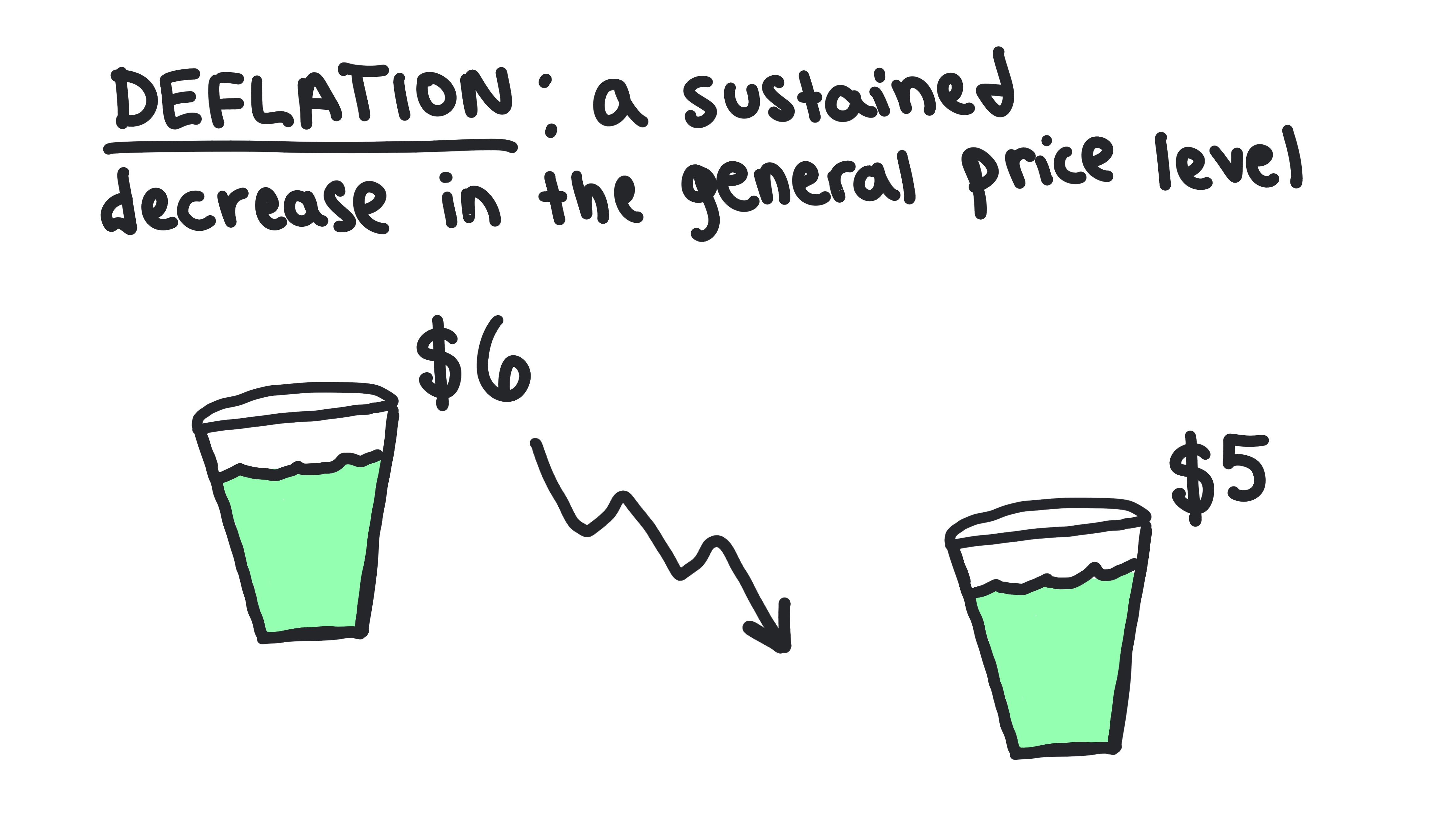
Deflation
A sustained decrease in the general price level; can signal a weak economy.
Disinflation
A decrease in the rate of inflation; prices still rise but more slowly.
Price Index
A measure tracking average price changes for a set of goods.
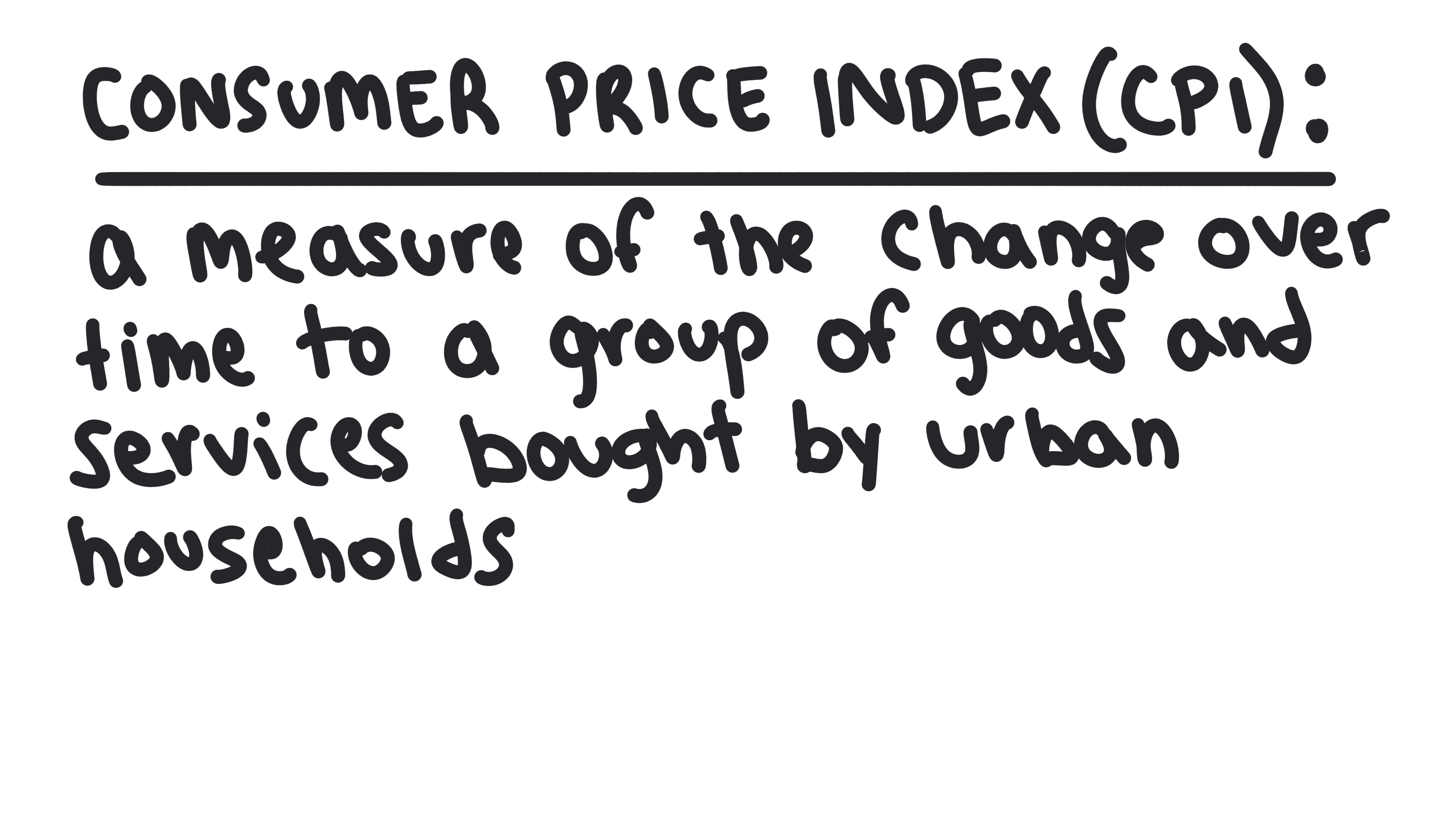
Consumer Price Index (CPI)
The most widely used price index, based on the cost of a fixed market basket of goods.
Market Basket
A hypothetical collection of goods and services used to track price changes for CPI.
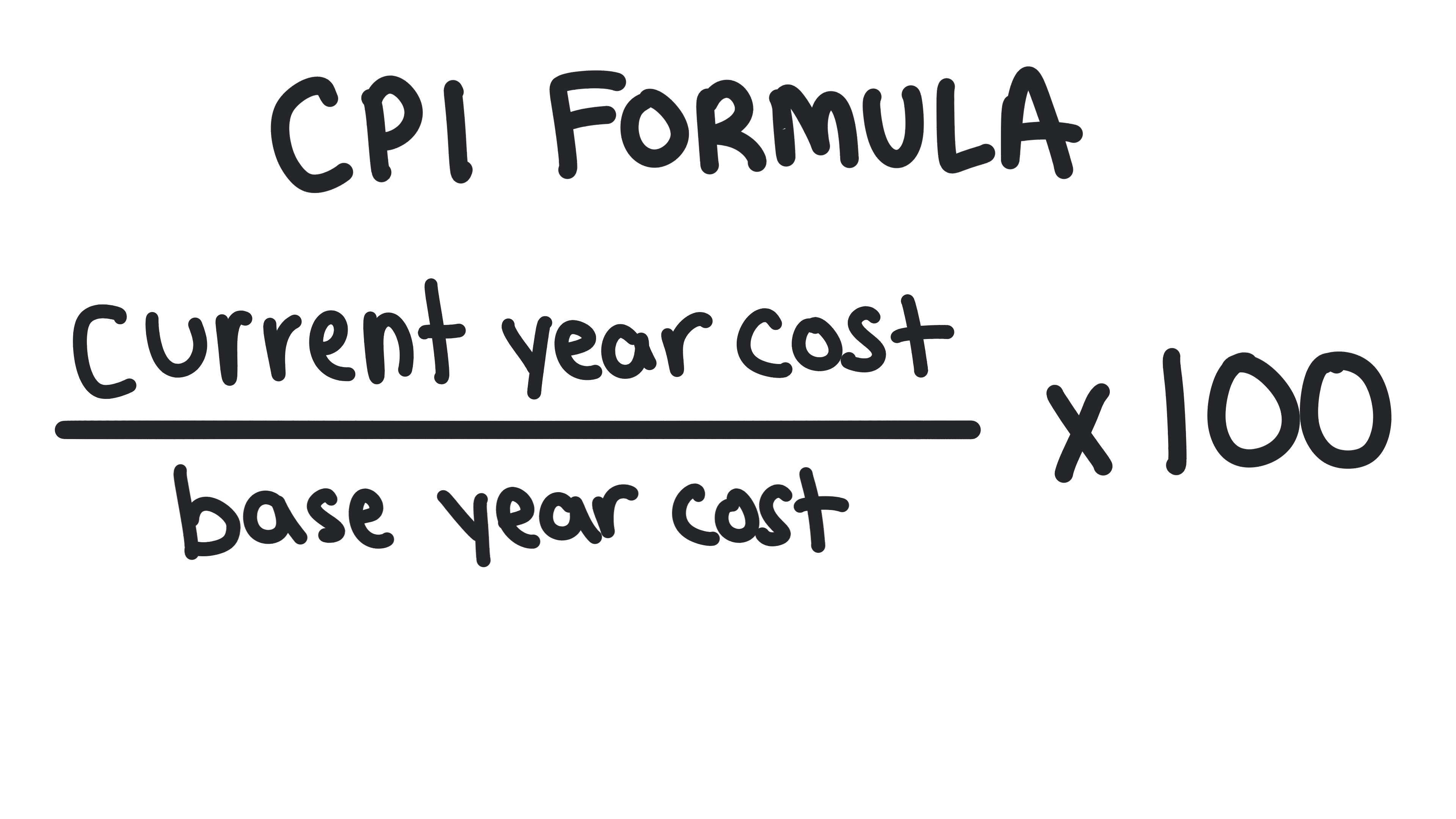
Calculating CPI
Formula for determining the Consumer Price Index.
- •Formula: (Cost of Market Basket in Current Year / Cost in Base Year) × 100
Calculating Inflation Rate
Formula for determining the percentage change in CPI.
- •Formula: ((New CPI – Old CPI) / Old CPI) × 100
Substitution Bias
Limitation of CPI where fixed basket ignores consumer substitution, overstating cost of living increases.
Quality Bias
Limitation of CPI where price changes from quality improvements are counted as inflation.
Whiteboards
Practice MCQs
Test your understanding of 2.4
If the Consumer Price Index (CPI) was 150 in Year 1 and 165 in Year 2, the inflation rate between Year 1 and Year 2 was:
2.5 - Costs of Inflation
Key Terms & Definitions
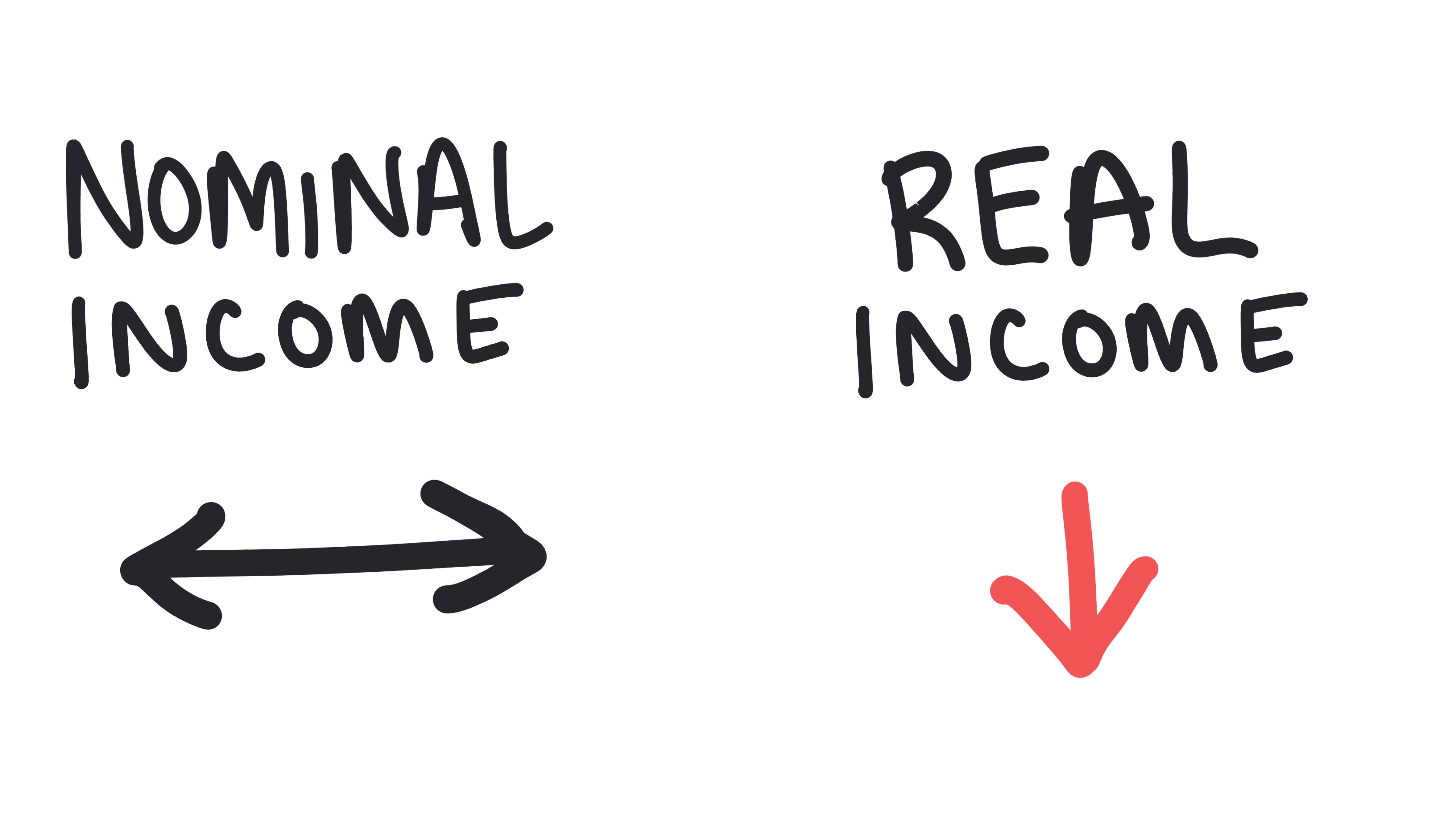
Nominal Variable
A value measured in current dollars, not adjusted for inflation.
- •Example: Nominal wage, nominal GDP, nominal interest rate
Real Variable
A value adjusted for inflation, reflecting actual purchasing power.
- •Example: Real wage, real GDP, real interest rate
Nominal Interest Rate
The stated interest rate on a loan, not adjusted for inflation.
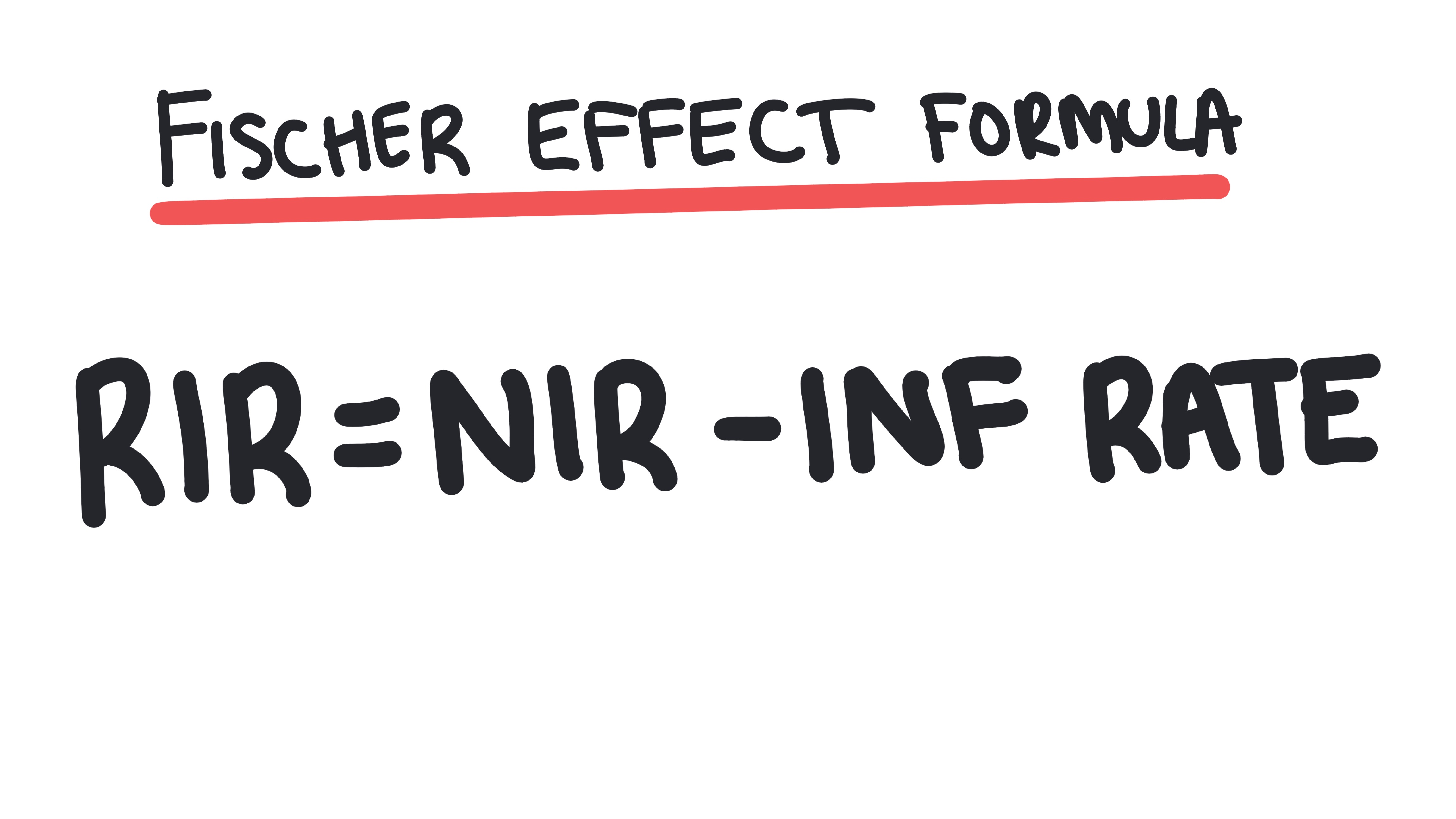
Real Interest Rate
The nominal interest rate minus the inflation rate, showing the true change in purchasing power.
- •Formula: Real Interest Rate = Nominal Interest Rate – Inflation Rate
Purchasing Power
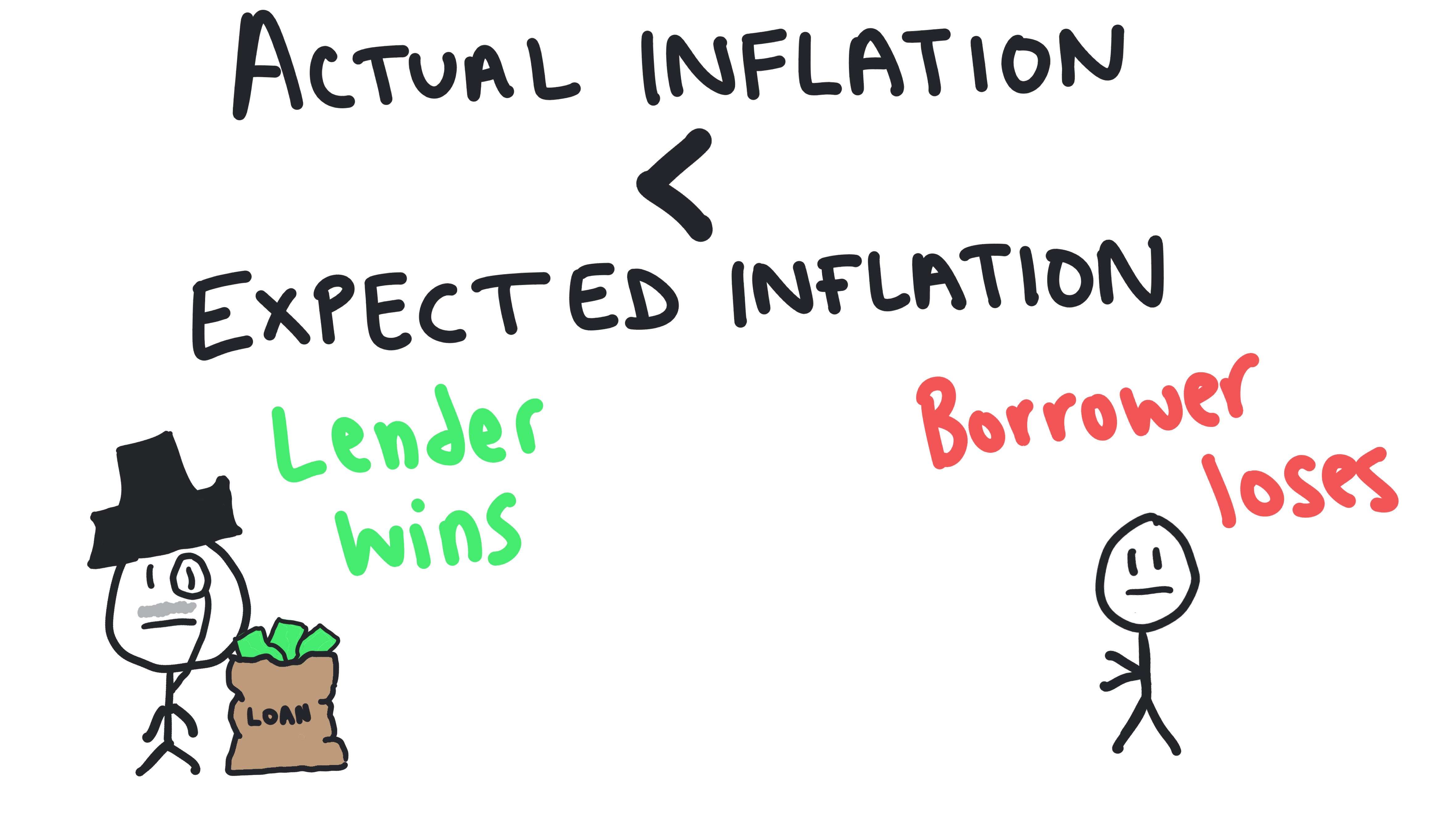
The quantity of goods and services money can buy; reduced by unexpected inflation.
Substitution Bias
A limitation of the Consumer Price Index (CPI) that occurs because consumers substitute away from goods that become relatively more expensive.
- •CPI uses a fixed basket of goods, but consumers actually change their spending patterns when prices change
- •Example: If the price of beef increases, consumers may buy more chicken instead, but CPI still weights beef the same as before
Whiteboards
Practice MCQs
Test your understanding of 2.5
Which group is most likely to be negatively impacted by unanticipated inflation?
2.6 - Real v. Nominal GDP
Real v Nominal GDP - Example Problem
Understand the key difference between nominal and real GDP
Key Terms & Definitions
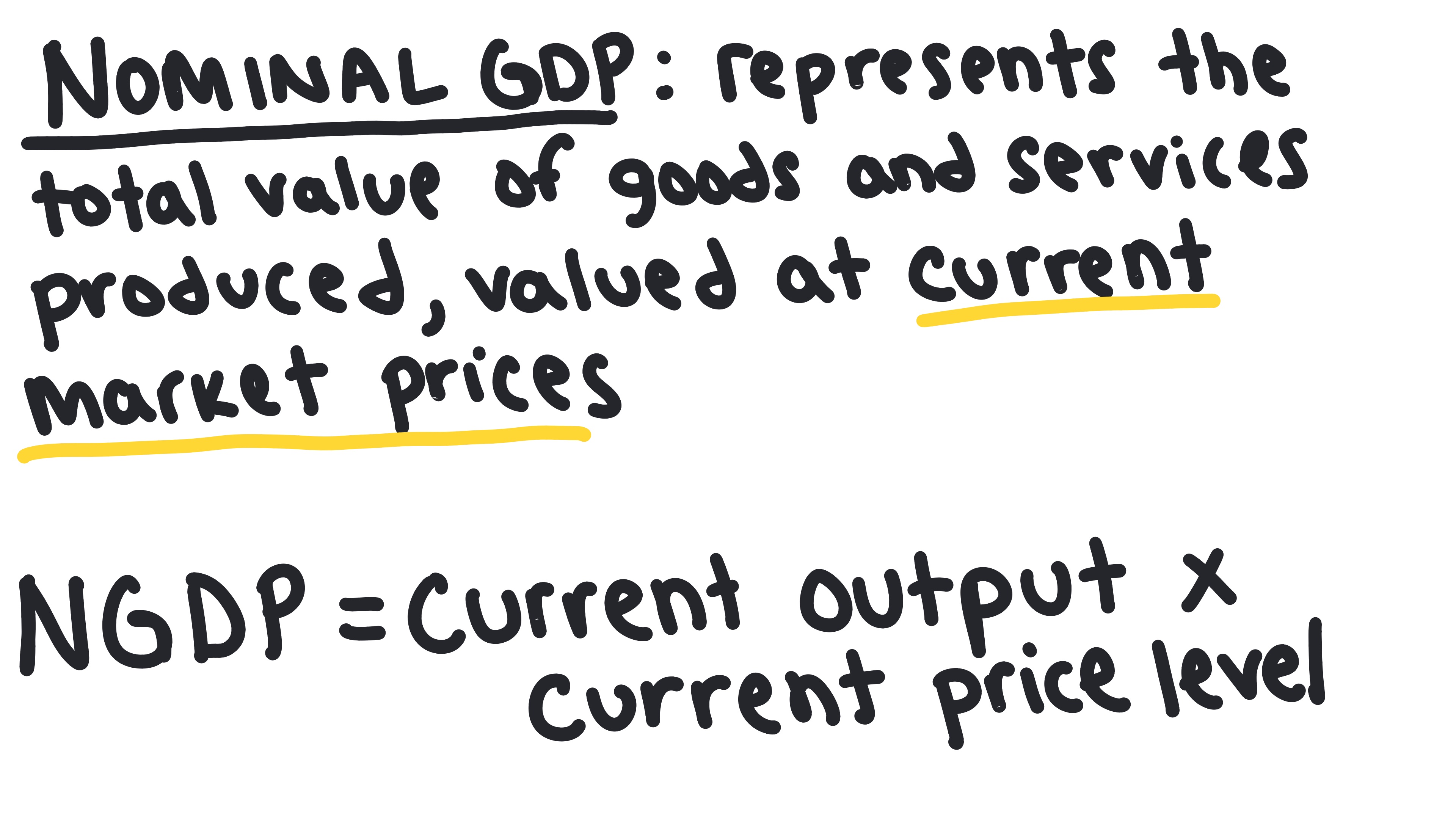
Nominal GDP
The value of output measured in current prices.
- •Formula: Nominal GDP = Real GDP × (GDP Deflator / 100)
Real GDP
The value of output measured in constant prices from a base year.
- •Formula: Real GDP = (Nominal GDP / GDP Deflator) × 100
- •When calculating real GDP using a table of goods and services, you can multiply the quantity of each good by the price of the good in the base year to get the real GDP.
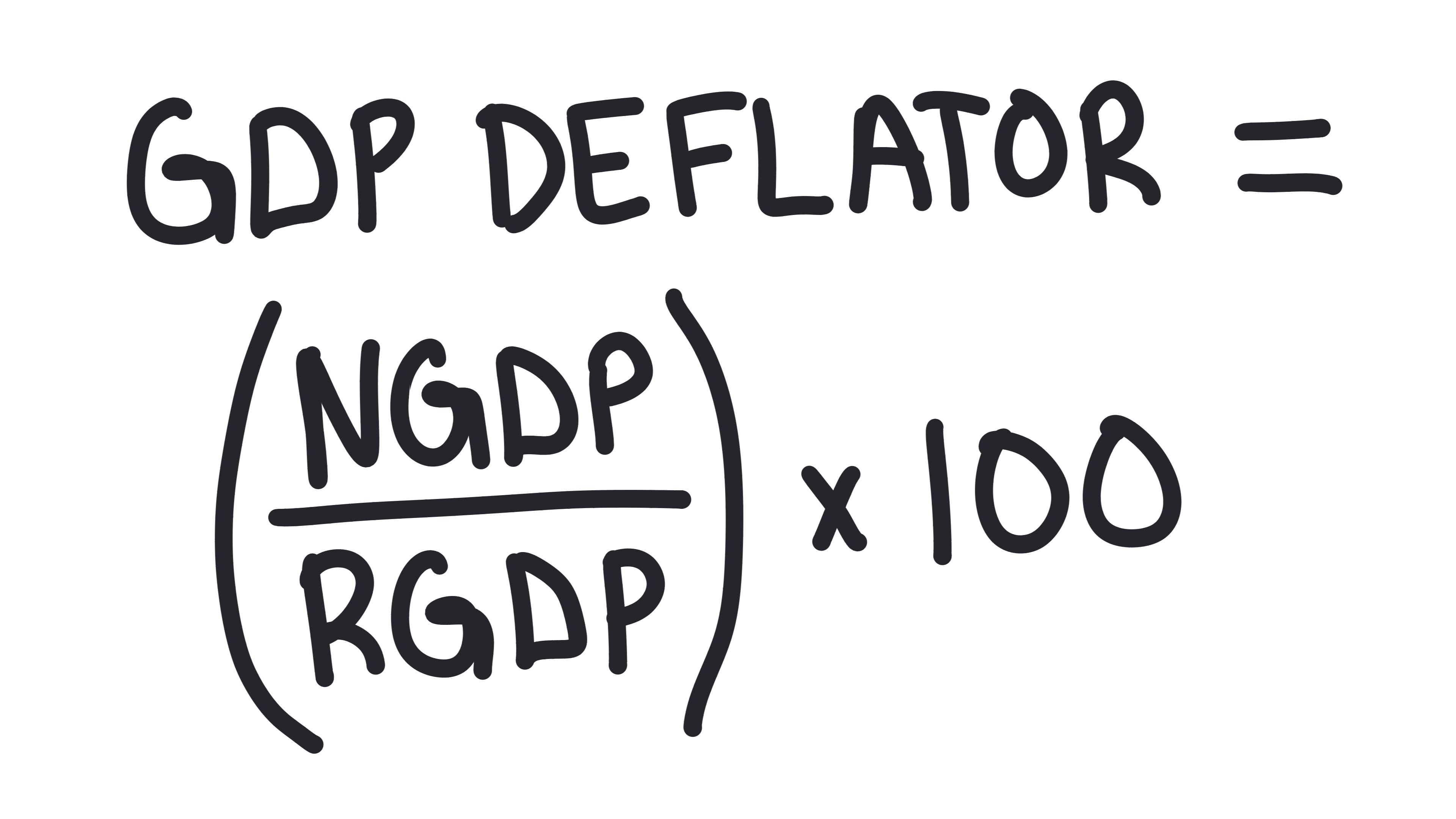
GDP Deflator
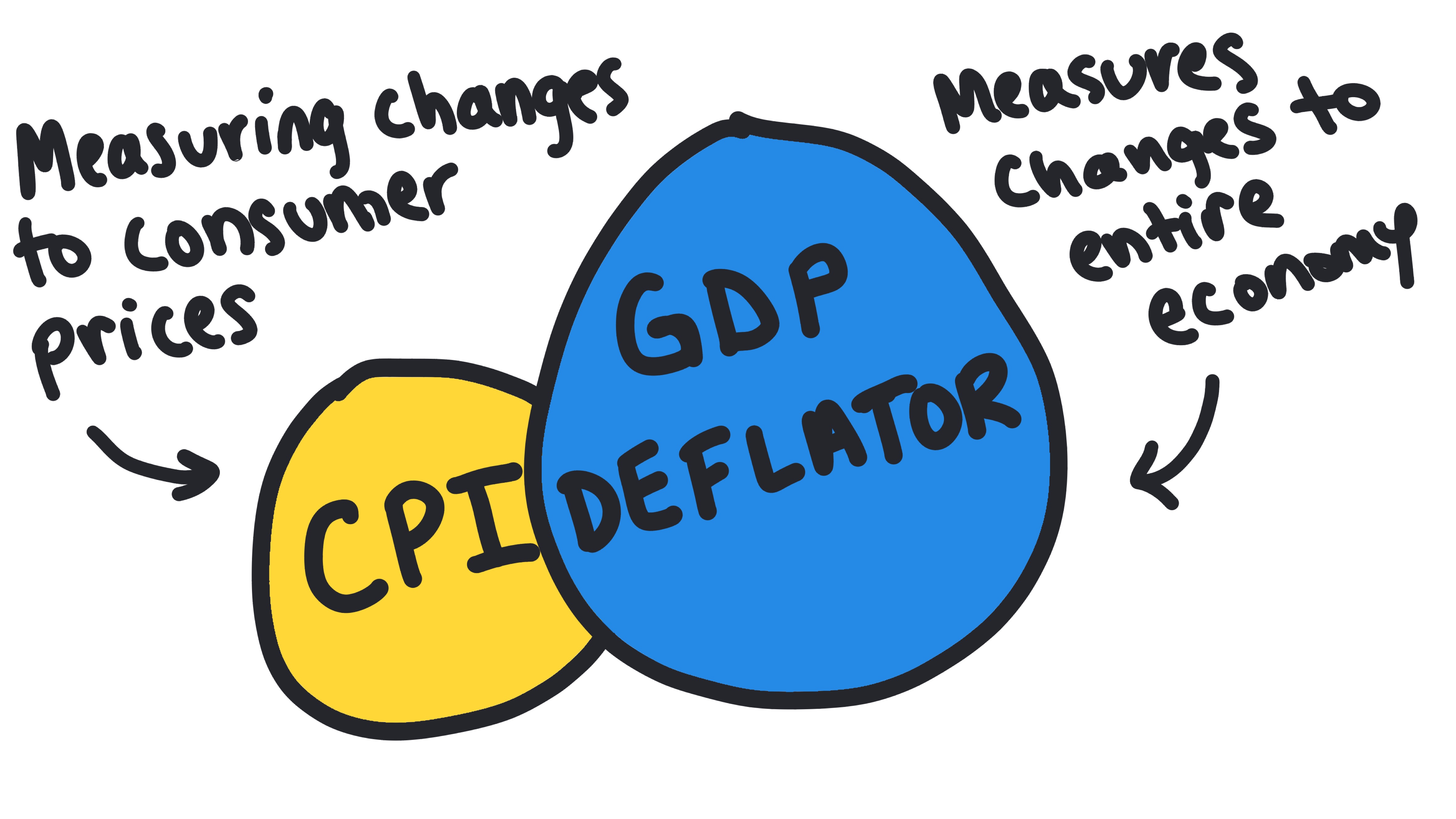
A price index measuring price changes for all goods and services in the economy.
- •Formula: GDP Deflator = (Nominal GDP / Real GDP) × 100
- •A broader measure than CPI because it includes all goods and services in the economy, not just a fixed basket of consumer goods.
Whiteboards
Practice MCQs
Test your understanding of 2.6
If Nominal GDP is $15 trillion and Real GDP is $12 trillion, the GDP Deflator is:
2.7 - Business Cycles
It's All Connected: The Business Cycle Graph, The AD-AS Model, and the PPC
Learn about the connection between the business cycles graph, the AS-AS graph, the a country's PPC
Key Terms & Definitions
Business Cycle
Short-run fluctuations in economic activity, alternating between growth and decline.
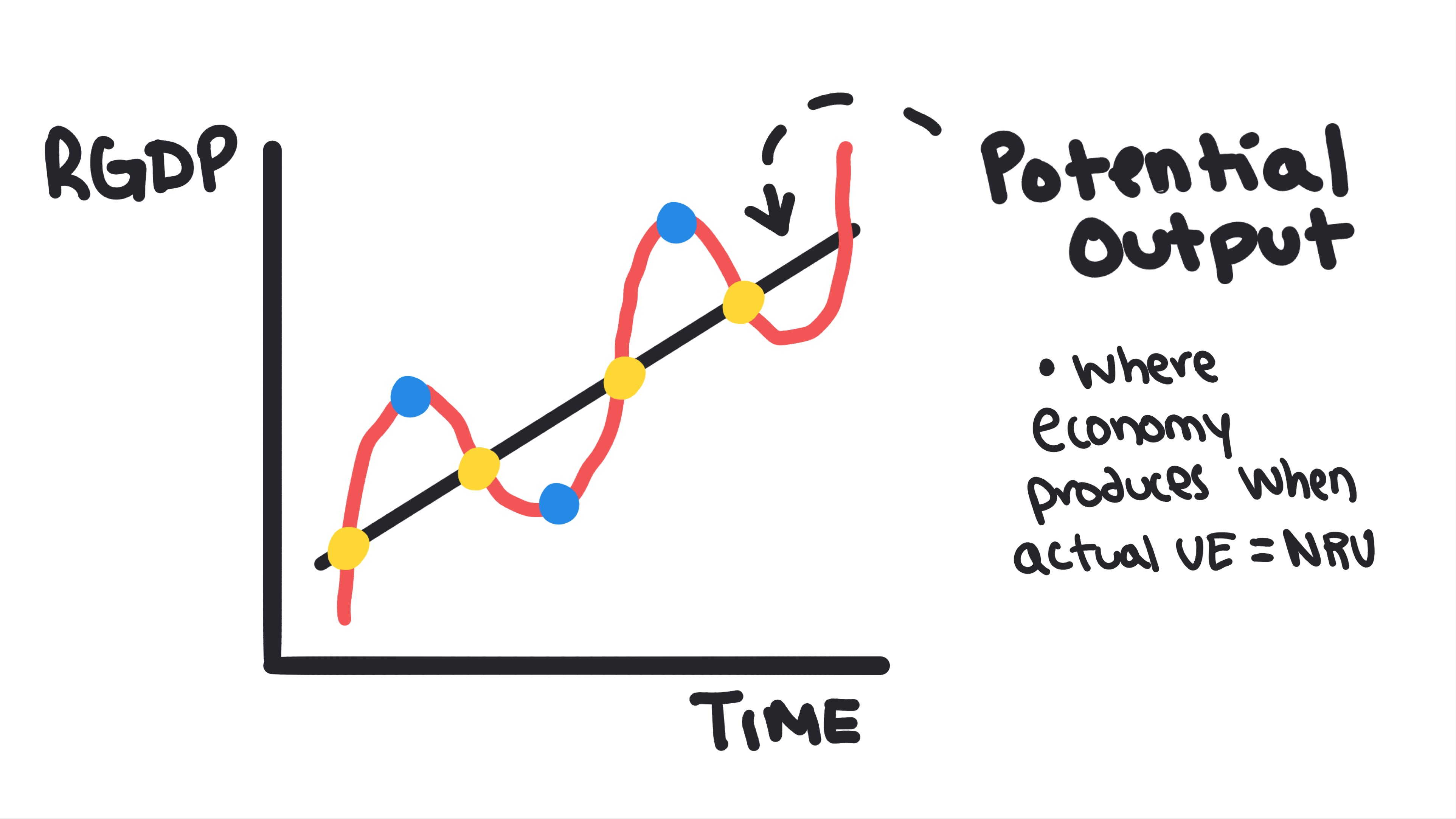
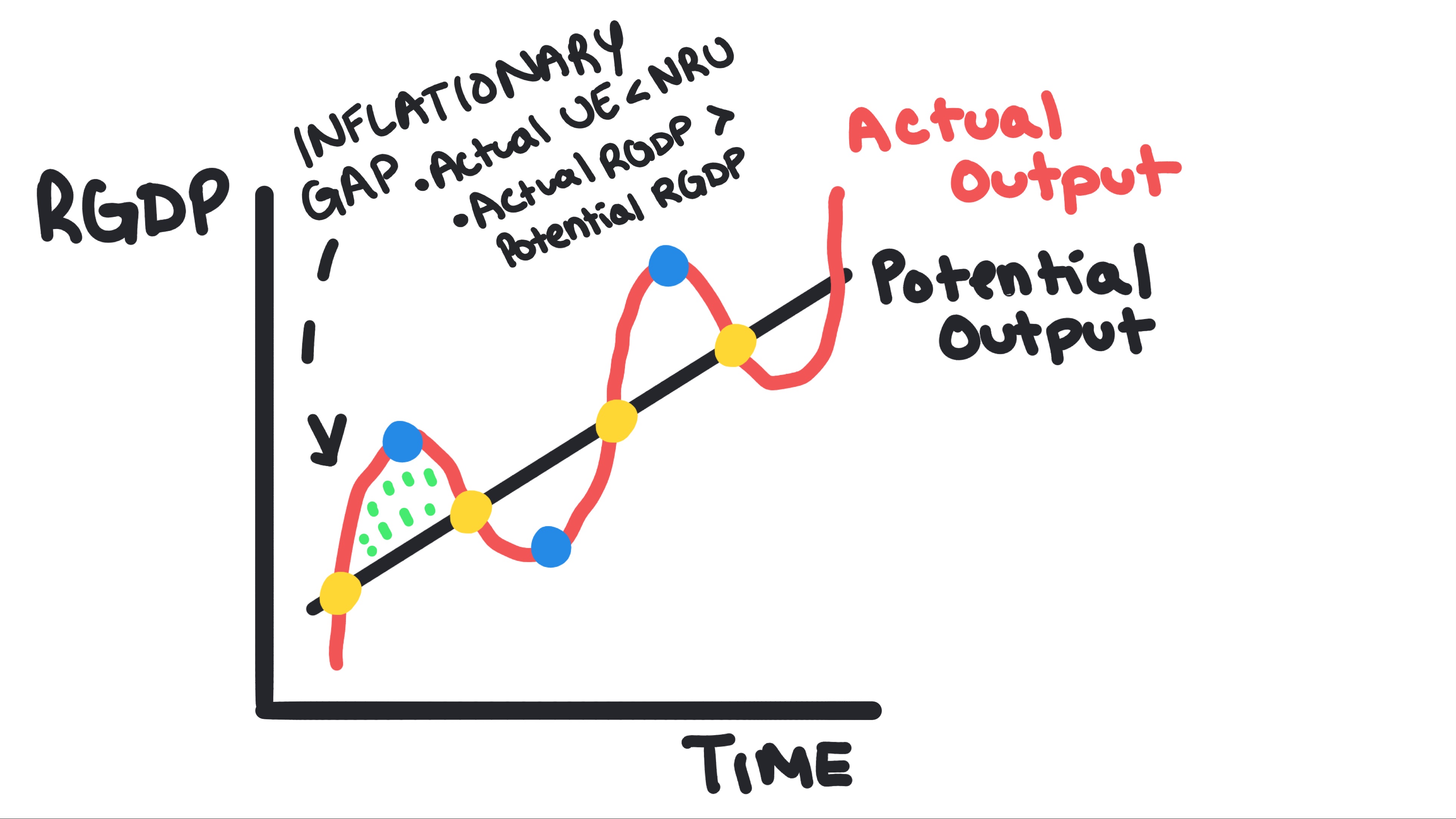
Potential Output
GDP level when the economy is at full employment; long-run growth trend.
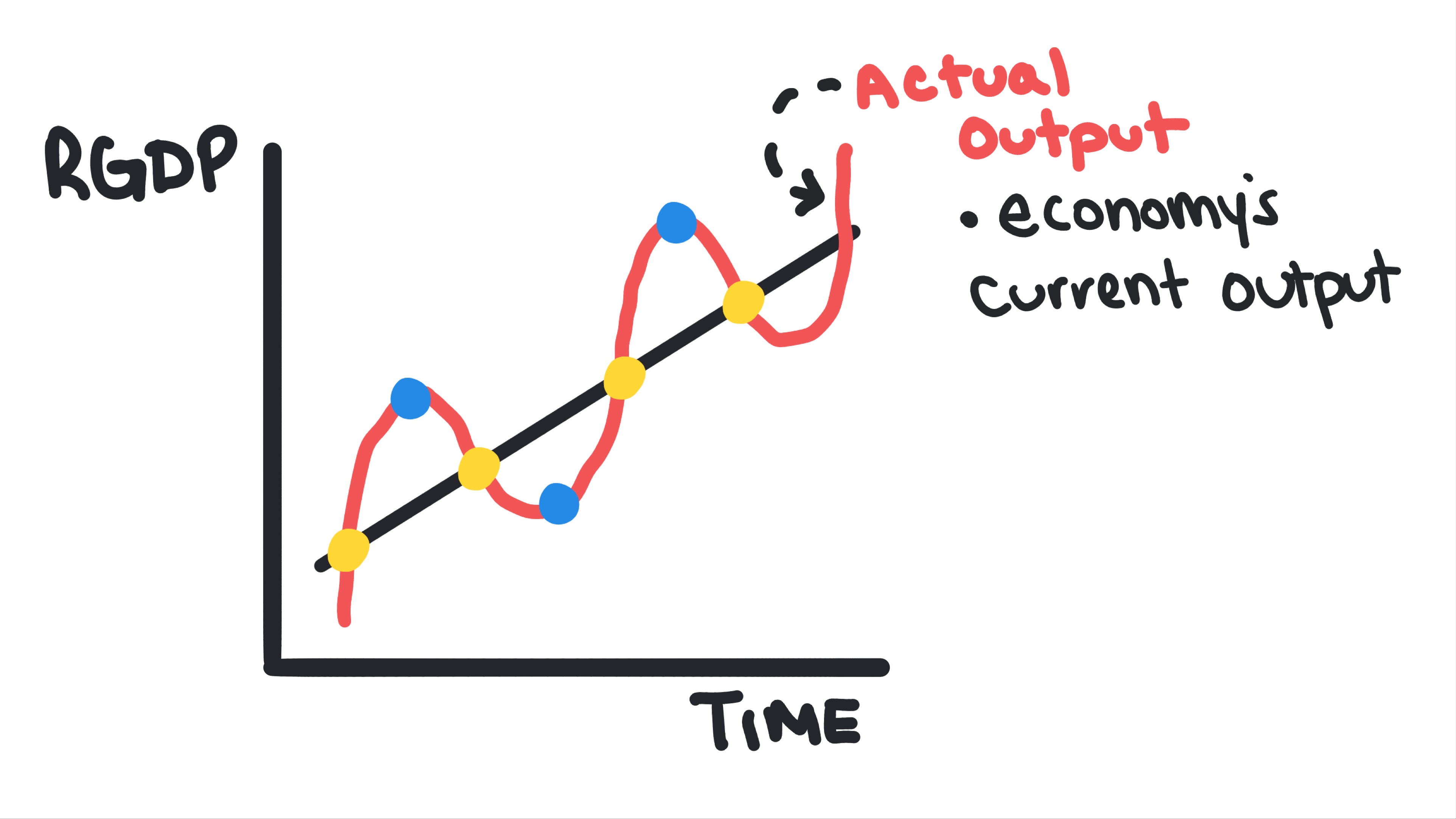
Actual Output
The GDP actually produced at a given time.
Expansion
Period of rising output, falling unemployment, and economic growth.
Peak
The highest point of an expansion, right before the economy begins to turn down.
Recession (Contraction)
A period when actual output is falling, the economy is shrinking, and unemployment is going up.
Trough
The lowest point of a recession, right before things start to get better and a new expansion begins.
Business Inventories
The stock of goods that businesses hold in anticipation of future sales. Rising inventories are a sign of economic recession, as businesses produce more than consumers are buying.
- •Rising inventories indicate that businesses are producing more goods than consumers are purchasing
- •This is a leading indicator of economic recession, as it suggests weakening consumer demand
- •During a recession, businesses accumulate inventory because sales decline faster than production can be adjusted
- •High inventory levels often lead businesses to reduce production and lay off workers, further deepening the recession
Output Gap
The space between the potential output line and the actual output line, which tells us a lot about the health of the economy.
Recessionary Gap
When actual output is below potential output and the unemployment rate is higher than the natural rate.
- •Actual output is below potential output
- •Actual unemployment rate is higher than the natural rate.
Inflationary Gap
When actual output is above potential output, causing the economy to "overheat," and the unemployment rate is lower than the natural rate.
- •Actual output is above potential output
- •Actual unemployment rate is lower than the natural rate.
Whiteboards
Practice MCQs
Test your understanding of 2.7
A worker who is laid off due to a downturn in the business cycle represents which type of unemployment?