Unit 4 - Imperfect Competition
Table of Contents
4.1 - Introduction to Imperfectly Competitive Markets
Key Terms & Definitions
Imperfect Competition
A market structure that fails to meet the conditions of perfect competition, where firms have some control over the price.
- •Includes Monopoly, Oligopoly, and Monopolistic Competition.
- •Firms are "Price Makers" rather than "Price Takers".
- •The Demand curve for the firm is downward sloping.
4.2 - Monopoly
Key Terms & Definitions
Monopoly
A market structure where there is only one large firm (the firm is the market) producing a unique product.
- •Characteristics: High barriers to entry, "price makers".
- •Marginal Revenue (MR) is less than Demand (Price).
- •There are no close substitutes for the good.
Marginal Revenue in Monopoly
The additional revenue from selling one more unit. In a monopoly, the MR curve lies below the Demand curve.
- •To sell more units, the firm must lower the price on ALL units sold, not just the last one.
- •MR < Price at every quantity after the first unit.
Elasticity and Total Revenue (Monopoly)
A monopoly will only produce in the elastic range of the demand curve.
- •Elastic Range: MR > 0. Total Revenue increases as Price decreases.
- •Inelastic Range: MR < 0. Total Revenue decreases as Price decreases.
- •Total Revenue is maximized where MR = 0 (Unit Elastic).
Inefficiency of Monopoly
Monopolies are inefficient because they charge a higher price and produce a lower quantity than perfectly competitive markets.
- •Allocatively Inefficient: Price > Marginal Cost (P > MC).
- •Productive Inefficient: Price > Minimum ATC.
- •Creates Deadweight Loss (DWL).
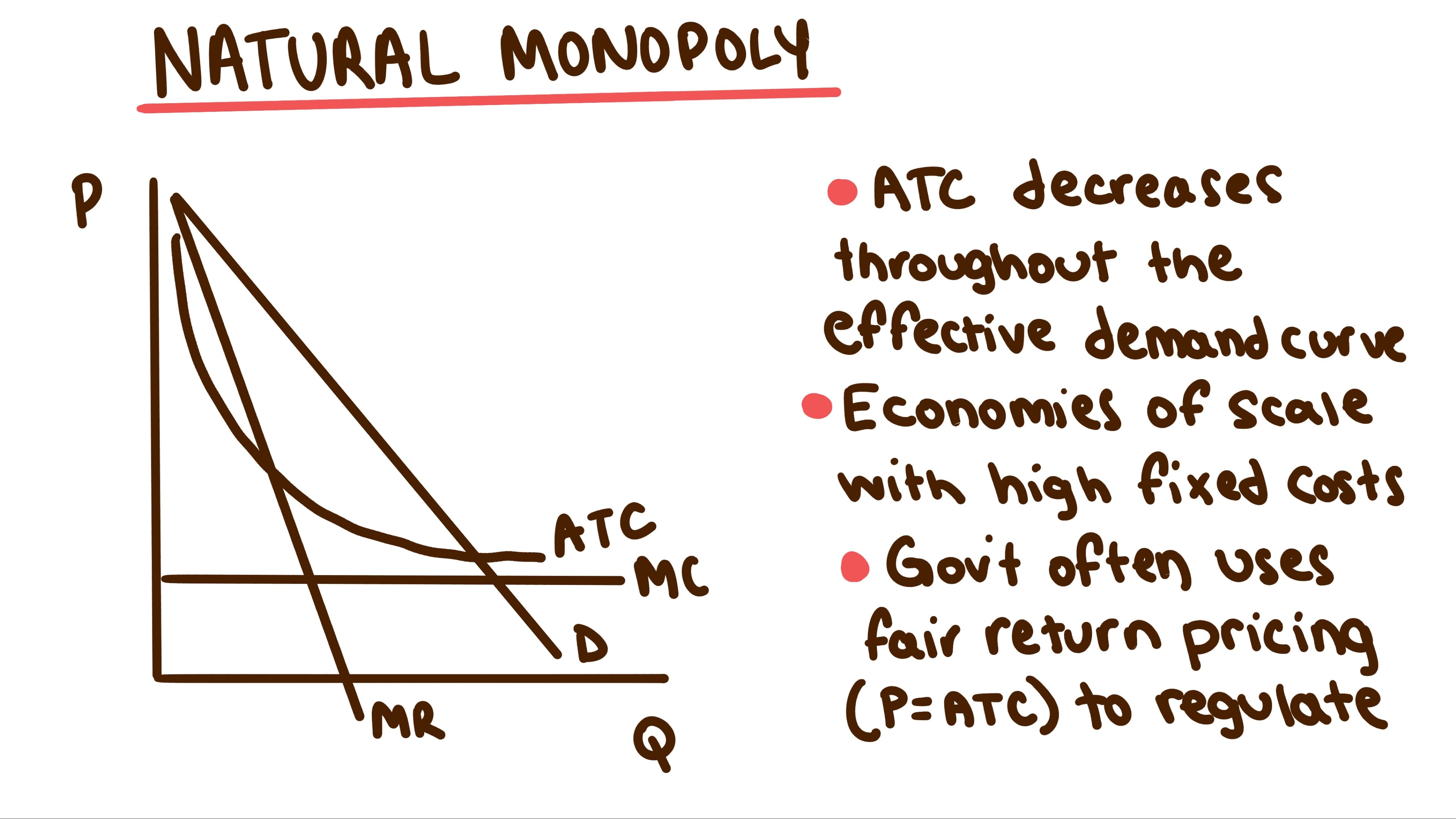
Natural Monopoly
A distinct type of monopoly where one firm can produce the socially optimal quantity at the lowest cost due to economies of scale.
- •The ATC curve falls over the relevant range of production.
- •It is better to have one firm because two firms would have higher average costs.
Regulating Monopolies
Government price controls used to reduce the inefficiency of natural monopolies.
- •Socially Optimal Price: Set P = MC (Allocative Efficiency). May cause a loss for the firm.
- •Fair Return Price: Set P = ATC (Normal Profit). Firm breaks even.
Whiteboards
4.3 - Price Discrimination
Key Terms & Definitions
Price Discrimination
The practice of selling the same product to different buyers at different prices based on their willingness to pay.
- •Conditions: Firm must have market power, be able to segregate the market, and prevent resale.
- •Result: Converts Consumer Surplus into Profit.
- •Perfect Price Discrimination: MR = Demand. No Deadweight Loss. Allocatively Efficient.
Checkpoint
Test your understanding of 4.1
Imperfectly competitive markets are characterized by:
Checkpoint
Test your understanding of 4.2
A monopolist produces where:
4.4 - Monopolistic Competition
Key Terms & Definitions
Monopolistic Competition
A market structure with many sellers offering differentiated products.
- •Characteristics: Relatively large number of sellers, easy entry and exit, non-price competition (advertising).
- •Products are substitutes but not identical (e.g., fast food, furniture).
Product Differentiation
Strategies used by firms to distinguish their products from competitors, such as branding, quality, or features.
- •Gives the firm some control over price (Demand is downward sloping but highly elastic).
Long-Run Equilibrium (Monopolistic Competition)
In the long run, firms enter or exit until economic profit is zero.
- •Entry/Exit shifts the Demand curve.
- •Equilibrium: Price = ATC (Normal Profit), but Price > MC (Inefficient).
- •Demand is tangent to the ATC curve.
Excess Capacity
The gap between the minimum ATC output and the profit-maximizing output.
- •The firm could produce at a lower cost but holds back production to maximize profit.
4.5 - Oligopoly and Game Theory
Key Terms & Definitions
Oligopoly
A market structure dominated by a few large producers.
- •Characteristics: High barriers to entry, identical or differentiated products.
- •Key Feature: Mutual Interdependence (decisions depend on competitors).
Game Theory
The study of how people/firms behave in strategic situations.
- •Used to analyze the pricing and output decisions of oligopolies.
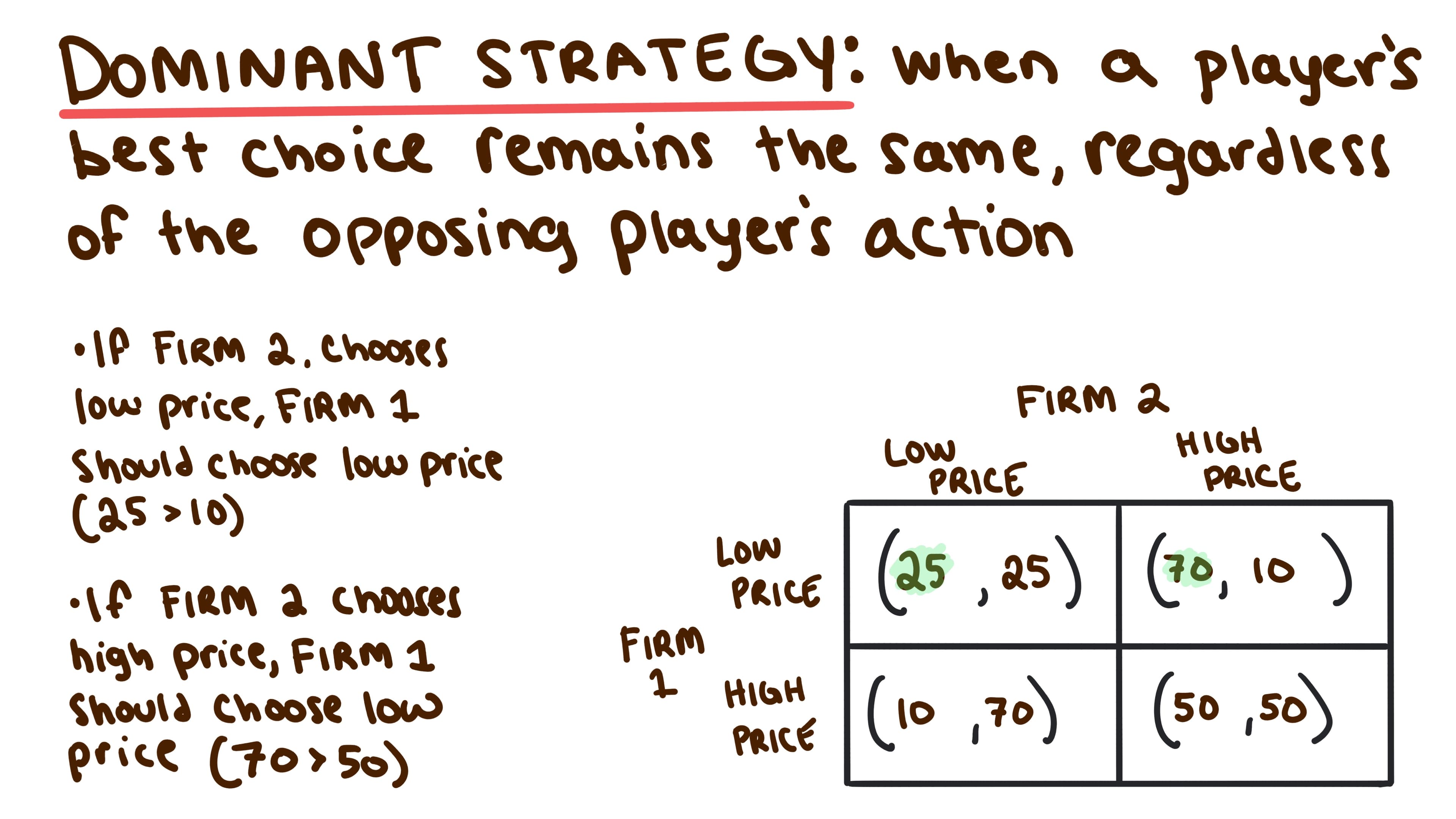
Dominant Strategy
The best move to make regardless of what your opponent does.
- •Not all games have a dominant strategy.
- •How to identify:
- •For Player 1: Check each row - if one row has higher payoffs than another in every column, that row is dominant.
- •For Player 2: Check each column - if one column has higher payoffs than another in every row, that column is dominant.
- •A strategy is dominant if it yields a better payoff than all other strategies, regardless of opponent's choice.
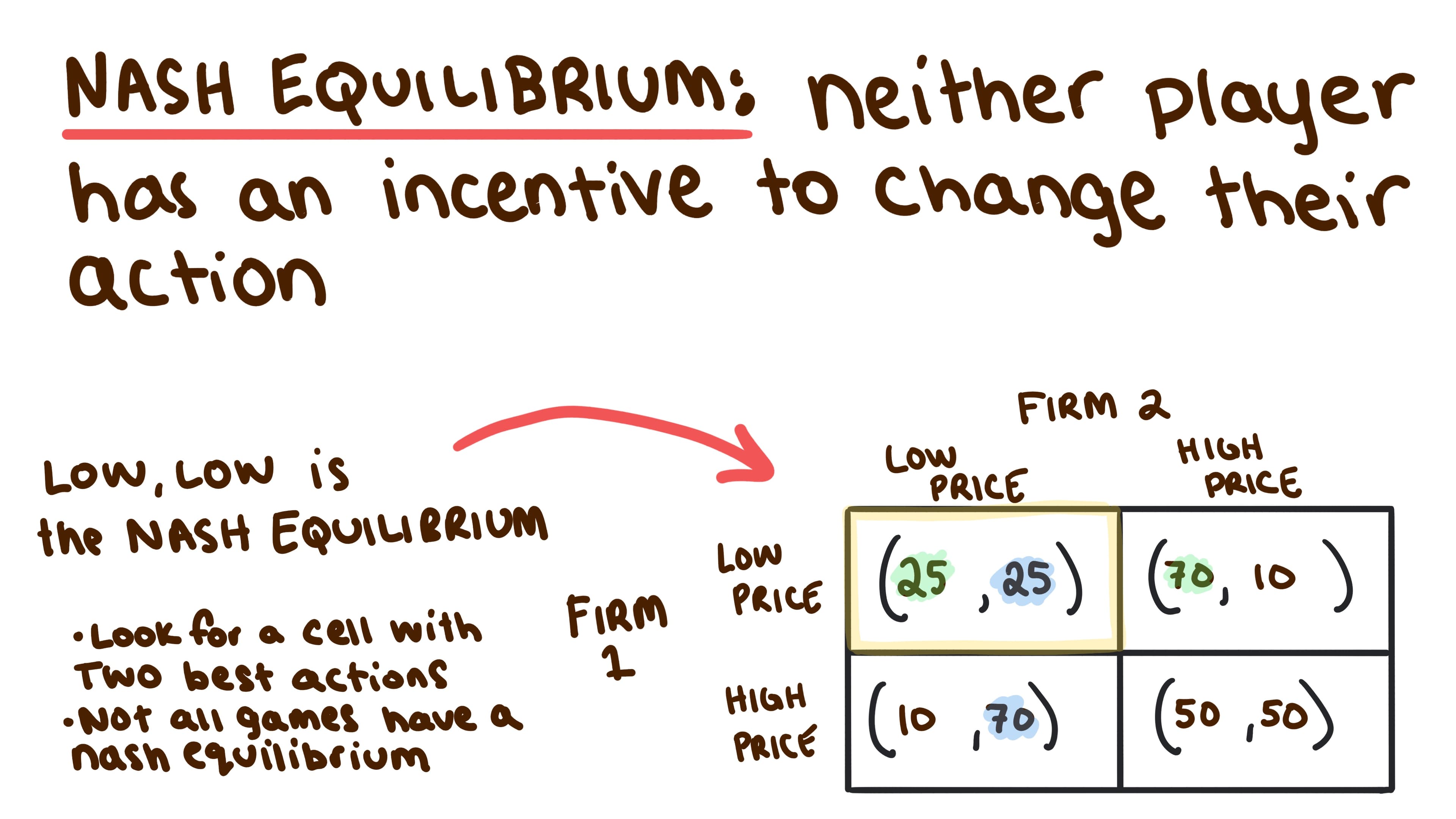
Nash Equilibrium
The outcome that occurs when both firms make decisions simultaneously and have no incentive to change.
- •The "optimal" outcome given the rival's choice.
- •How to identify:
- •Step 1: For each cell, check if Player 1's payoff is the highest in that column (best response to Player 2's strategy).
- •Step 2: For the same cell, check if Player 2's payoff is the highest in that row (best response to Player 1's strategy).
- •If both conditions are true, that cell is a Nash equilibrium.
- •A Nash equilibrium can exist even if neither player has a dominant strategy.
Collusion / Cartel
A group of producers that create an agreement to fix prices high, effectively acting as a monopoly.
- •They restrict output to maximize collective profit.
- •Cartels are unstable because firms have an incentive to cheat (lower price) to gain market share.
4.6
Whiteboards
Checkpoint
Test your understanding of 4.4
Monopolistic competition is characterized by:
Checkpoint
Test your understanding of 4.5
In game theory, a Nash equilibrium occurs when: